A Borrowing Shelf for the Things Used Once in a While
A borrowing shelf gives neighbours access to occasional-use items without creating a burden. Choose its purpose, set clear return expectations and keep it manageable.
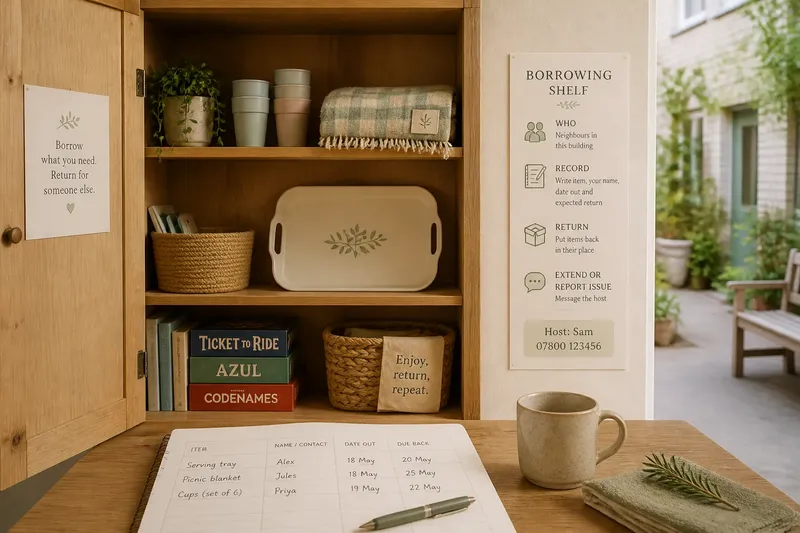
What could neighbours borrow without turning a simple offer into another job for someone? A borrowing shelf works best when its purpose is narrow, its return expectations are visible and its upkeep fits the place that hosts it. The right arrangement may be a cupboard for practical tools, a small collection of picnic kit or a shelf of shared kitchen equipment; it need not become a general store of everything people might want.
Start with one kind of need
Before collecting objects, listen for a recurring, occasional-use need. The aim is not to replace a neighbour’s possessions or provide a full lending service. It is to make a few useful items easier to access when buying or storing them individually seems unnecessary.
A narrow purpose gives the shelf a recognisable shape. A building with a shared courtyard might focus on outdoor gathering: a folding picnic blanket, reusable cups and a serving tray. A residents’ hall might keep basic event supplies, while a community room could offer a small selection of board games. These are distinct arrangements, not categories to combine automatically.
Consider the host site, too. A shelf in a staffed community centre can be checked during normal opening hours. A hallway cupboard in a block of flats needs a named contact and a way to prevent access from obstructing shared space. If nobody can see or tend the items, a collection that depends on frequent attention is unlikely to remain easy.
Write the purpose in one sentence before inviting contributions. If an item does not fit that sentence, leave it out.
Three borrowing models
Different models suit different places. The simplest choice is the one whose routine matches the site’s existing habits, rather than the one with the most elaborate system.
Open shelf
Items sit in a clearly marked, accessible spot, with a notebook or card for recording what leaves and returns. This suits a small, familiar group with a shared entrance or common room where people pass regularly. It asks little of a volunteer, but depends on neighbours understanding the arrangement and making a brief record.
Host-held cupboard
A named host keeps items in a cupboard and lends them directly, perhaps when the community room is open. This suits equipment that needs tidier storage or a quick condition check, and places where staff or volunteers are already present. It is less convenient outside opening times, so it should not be chosen if borrowers are likely to need access at unpredictable hours.
Occasional lending table
Items are brought out at a regular communal gathering and returned at the next one, with a simple borrowing card. This suits a group that already meets and prefers a visible, social exchange over storage in a shared corridor. It is a poor fit for urgent or spontaneous needs, since access follows the gathering schedule.
Choose according to access and care: open shelf for easy routine borrowing, host-held storage for closer oversight, or a lending table when the group already gathers.
Make returns visible
People should be able to understand the arrangement without asking the person who started it. Put a short sign beside the items, not on a distant noticeboard. It can state who may borrow, how to record an item, where it belongs on return and whom to contact if it is damaged or missing.
Use a small card or notebook with only the details the group needs: item, borrower’s name or agreed contact, date taken and expected return. If the group would rather avoid personal details on display, a host can keep the record in a closed folder. The method matters less than making the next action obvious.
Set a return period that reflects how the item is used, rather than choosing a universal rule. A serving tray for a gathering may be needed back promptly; a board game could reasonably stay out longer. Say what to do if someone needs extra time. A friendly reminder route, such as a message to the host, is more useful than a stern notice that makes ordinary delay feel like wrongdoing.
Imagine a block’s shelf is intended for shared courtyard gatherings and holds cups, a blanket and a tray. A neighbour borrows the tray for a small celebration, writes their name and return date on the card, then notices the date conflicts with another gathering. If the sign gives the host’s contact and invites people to agree an extension, the neighbour can ask before the next group needs it; the visible record also tells others that the tray is already out.
Keep the collection manageable
A borrowing shelf can grow through well-meant donations until it becomes difficult to use. Agree that contributions are accepted only when they match the stated purpose, are clean and complete, and have a sensible place to live. More items do not necessarily make the arrangement more useful.
Choose objects that can be checked at a glance. A board game should have its pieces together; reusable cups should be clean and stored dry; a picnic blanket should be folded and labelled. Avoid donations with unclear condition, missing parts or complicated care. The point is to share ordinary items, not create a repair project.
- Purpose: Does the item fit the shelf’s stated use?
- Condition: Is it clean, complete and ready to borrow?
- Storage: Is there a clear place for it to return?
- Care: Can a borrower understand any simple cleaning or handling request?
- Responsibility: Is it clear who to contact if something goes wrong?
For electrical, food-contact or otherwise safety-sensitive items, follow the manufacturer’s instructions and relevant local rules; if these are unclear, leave the item out. Keep the collection to objects the host can reasonably oversee.
Choose a light-touch routine
Maintenance should be a small, predictable task, not an open-ended promise. The host might glance over the shelf when using the room, check the borrowing card at a regular gathering or ask a second neighbour to share the occasional review. A routine tied to something already happening is easier to sustain than a separate inspection schedule.
When an item is overdue, send one courteous reminder through the agreed contact route. If it cannot be returned, ask the borrower to say so; the group can then decide whether to replace it, remove it from the collection or carry on without it. Keep the response proportionate. A shared shelf is a neighbourly convenience, not a formal lending institution.
Periodically ask whether people still use the items and whether the stated purpose remains useful. Retire things that sit untouched or take disproportionate effort to store. If the collection keeps expanding, return to the original sentence and narrow it again rather than adding a catalogue or a web of rules.
Which model fits your place?
Is an open shelf suitable for a shared hallway?
It can suit a small, familiar group if the shelf stays within an agreed shared area and does not obstruct access. If neighbours cannot see the items or record what they take, a host-held cupboard may be clearer.
What should a borrowing shelf contain?
Choose a few occasional-use items that meet one defined need and can be stored and checked easily. Ask neighbours what they would actually borrow before accepting donations.
How should borrowers return items?
Post the return place, expected timing and contact route beside the shelf, then use a simple card or notebook to show what is out. Make it easy to request an extension or report a problem.
Who should maintain the shelf?
Name a host or a small pair of neighbours, and connect checks to an existing routine at the site. If no one can take that modest responsibility, pause the plan or choose a model that requires less oversight.
For a first borrowing shelf, choose one purpose, one access model and a small set of items. The main search phrase, borrowing shelf, describes a modest arrangement best when its boundaries are as visible as the objects: neighbours know what belongs, how to borrow and when to bring it back.
Before accepting the next donation, ask whether it makes borrowing simpler for someone else. If the answer is unclear, a polite refusal may protect the usefulness of the whole shelf.