Before the Noticeboard: How Neighbours Passed Along Local News
Neighbourhood word of mouth travelled through familiar errands and small courtesies; learn how to trace these local memories without treating examples as established custom.
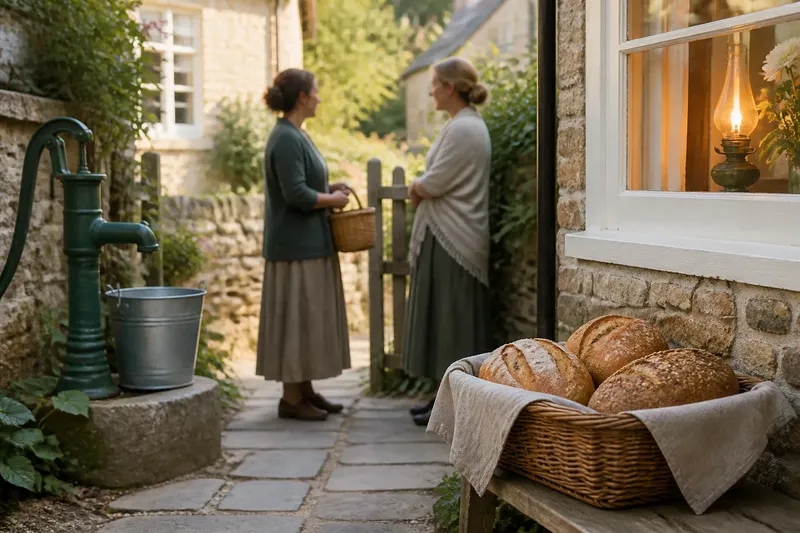
How can you tell whether a remembered route or signal was a local custom, rather than an illustrative possibility? Neighbourhood word of mouth often travelled through ordinary encounters, but a baker’s counter, a shared pump or a light in a window should be treated as examples unless local testimony or records support them.
Routes and errands
People who shared routines could meet while fetching supplies, returning borrowed tools or walking between homes. Those settings make plausible places for news to pass, but they do not establish that a particular route existed in every neighbourhood—or that anyone used it as an informal message service.
When tracing a local memory, begin with what a person actually recalls: where they were, what they were doing and who else was present. Then distinguish that direct recollection from a route suggested later as a possibility. A shop counter mentioned by a witness is evidence of that encounter; a baker’s counter offered as an example is not evidence of a local custom.
Different daily routines may also have brought people into contact with different households. Treat that as a question to investigate, not a general historical claim: ask who regularly visited which places and how the account supports that detail.
Write down the recalled place before proposing what it might have meant.
Signals and shared meaning
A light in a window, an open door or an object near a gate could serve as a signal in a particular household or community. Without a local account explaining its meaning, however, each remains an illustrative possibility rather than proof of a recognised custom.
To document a signal, ask who used it, what it meant to the people involved and how others learned that meaning. Look for more than one recollection where possible, while keeping each person’s account distinct. A neighbour’s interpretation may differ from the sender’s intention.
Signals can be ambiguous. Someone might miss one, misunderstand it or encounter it after its meaning had changed. A careful account preserves those uncertainties instead of smoothing them into a settled rule.
Messages in transit
As news passed from person to person, a retelling might include a useful detail, leave out something irrelevant or blur the difference between direct knowledge and hearsay. That possibility is a reason to ask how a story travelled, not a claim that every exchange changed the message.
Say you are recording an invented account: a neighbour says they heard that a footpath might close for repairs, but cannot name a confirmed date. You note the speaker’s uncertainty, ask whether they saw an announcement, and record that no confirmation was described. If another person later recalls a notice, you keep that as a separate account until its source is clear. The resulting note says a closure was reported as possible, not that it was officially announced.
For each remembered message, separate what someone saw, what they heard from another person and what they inferred.
Trust and privacy
Familiarity may have helped people judge whose account to pass on, but it did not itself prove that a messenger was reliable or authorised to share private information. Memories of who was told first, who was left out and why can reveal how people understood care and discretion; they should not be used to assign motives without evidence.
When an account concerns illness, money or a disagreement, ask whether the person sharing it has permission to be identified. If not, keep identifying details out of the record. Where the account is unclear, say so rather than presenting a private exchange as public neighbourhood knowledge.
Questions about local news?
How can you check a remembered route?
Ask the person recalling it to name the place, routine and people they remember, then distinguish those details from anything inferred later. A map, diary or local record may help corroborate the account, but absence from a record does not by itself settle what happened.
How should you describe a signal?
Record the specific object or action and who says it had a meaning. If nobody can explain how that meaning was shared, describe it as an individual recollection rather than a neighbourhood-wide convention.
How do you preserve uncertainty?
Use precise wording such as “I was told” or “the date was not confirmed” when that matches the account. Keep later or conflicting recollections separate instead of merging them into a single confident version.
What belongs in a local memory?
Include the setting, the speaker’s relationship to the event and whether the detail is firsthand or repeated. Leave out private information unless the person concerned has agreed to its inclusion.
Recording the setting
A useful account gives readers enough context to understand how a conversation might have happened without claiming more than the evidence supports. Use the following checks when taking notes; each result points to a clear next decision.
- Place: Check whether the speaker names a specific location; if they do, record it as remembered, then seek corroboration if the claim matters, and if they do not, mark the setting as unknown rather than supplying one.
- Routine: Check whether an errand or shared activity is recalled; if it is, record the activity and who described it, and if it is only a suggested example, label it as illustrative.
- Source: Check whether the speaker saw or heard the event directly; if directly, record that basis, and if through another person, note the chain as far as it is known.
- Signal: Check whether someone explains what an object or action meant; if they do, attribute that meaning to the source, and if not, describe the object without calling it a custom.
- Privacy: Check whether the account includes sensitive personal details; if permission to identify the person is clear, record only what is relevant, and if permission is absent or uncertain, anonymise or omit those details.
- Corroboration: Check whether another independent account or record supports a detail; if one does, note what it supports, and if none is available, preserve the detail as unconfirmed rather than treating it as false or established.
Neighbourhood word of mouth is best remembered through specific people, places and accounts, not through a universal story of everyone knowing everything. When you record a local exchange, the most useful detail may be the boundary of what can be known: who recalled it, what they could confirm and what remains only a plausible example.