Why an Open Invitation Can Still Feel Hard to Join
An open invitation can still feel hard to join. Learn how clear event details help newcomers understand the purpose, expectations and practical arrangements.
What does “everyone is welcome” mean if you cannot tell what the gathering is for or what it asks of you? At a neighbourhood supper, a newcomer might know the hall’s address but not whether the evening is a shared meal, a fundraiser or a residents’ meeting.
The uncertainty is not always about how to enter a room. It can be about the purpose of the event, its customs and the expectations attached to taking part. A useful invitation makes those terms clear without asking people to commit before they know what they are joining.
The promise and the purpose
An open invitation signals goodwill, but it can leave important questions unanswered. Is the gathering mainly social, or is there a practical task to do? Is it organised around a faith, a campaign or a particular group of residents? Can someone come to listen without joining the discussion?
Regulars may regard these details as obvious because they know the local context. A newcomer cannot be expected to infer it from a cheerful poster or a familiar venue name. Clarity is especially useful when an event’s title could describe several different activities.
State the purpose in ordinary language, then explain any expectations that follow from it. If there is a discussion, say what it concerns; if there is a shared meal, explain whether guests are expected to contribute food.
Customs made visible
Local customs often help a gathering feel distinctive. They can also be difficult to read from the outside. A regular may know that the first part of a meeting is reserved for updates, or that the annual picnic includes a short remembrance. A newcomer may not know when to speak, what to bring or why a particular moment matters.
Explaining a custom does not require a long account of its history. A sentence on the invitation can give enough context: “We begin with a short update on the garden, then share lunch; visitors are welcome to listen or join the discussion.” This tells people what will happen and makes clear that speaking is not compulsory.
Where a custom is meaningful to the group, describe its meaning respectfully rather than presenting it as a rule everyone must already understand.
Expectations before attendance
People often decide whether to attend based on practical and social expectations. They may need to know if the event is open to children, whether a contribution is optional, or whether the gathering is intended for people living in a specific area. Explain relevant limits plainly, including any reason for them, rather than using “everyone” if the event has defined eligibility.
- Check whether the event has a specific purpose; if the flyer gives only a name, add a plain-language description.
- Check whether guests are expected to bring food or supplies; if contributions are optional, say so, and if they are needed, name what is useful.
- Check whether the event is open to children; if it is, mention any arrangements families need to know, and if it is not, explain the limit clearly.
- Check whether attendance is limited to a particular group or area; if so, state who can attend and how someone unsure can ask, rather than implying unrestricted access.
- Check whether the gathering includes a custom that may be unfamiliar; if it does, explain its purpose briefly, and if not, avoid adding needless background.
- Check whether participation involves speaking, helping or making a contribution; if any action is optional, label it optional, and if it is required, state that before people arrive.
For each detail, the decision should be simple: explain the expectation, remove it if it is unnecessary, or make its limits clear before attendance.
When should an invitation explain more?
Should every event include a full schedule?
No; a brief outline is enough when the event is informal and its sequence is simple. Add more detail when the order of activities affects what guests should bring, prepare for or decide.
How can organisers describe a local custom?
Name what happens and give a short reason or context if it may not be clear to visitors. Avoid implying that newcomers should already know the custom.
What if an event is not open to everyone?
Say who it is for and explain the relevant boundary in direct, respectful language. If people can ask about eligibility, provide a clear contact route rather than leaving them to guess.
How much participation should be expected?
Distinguish between required and optional actions, such as speaking, bringing food or helping with a task. If listening is welcome, say so; if a contribution is necessary, describe it before the event.
A worked invitation
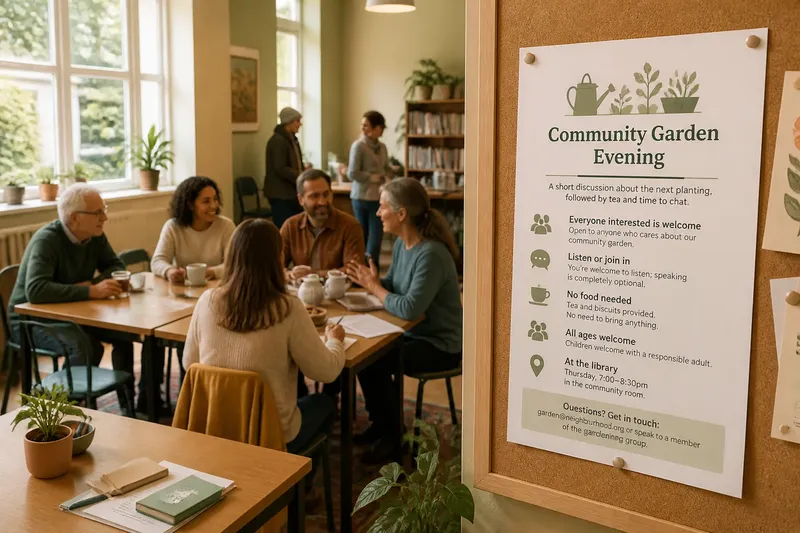
Say a neighbourhood group plans an evening about its shared allotment. The existing flyer says only “Garden gathering, Thursday at the library”. A newcomer cannot tell whether this means a social event, a planning meeting or a work session.
The organisers first identify the event’s purpose: they will discuss the next planting and share tea. They decide that bringing food is not needed, that guests may listen without speaking, and that the conversation is open to anyone interested in the allotment. They then revise the invitation: “Join neighbours at the library for a short discussion about the next planting, followed by tea. You are welcome to listen; no food or gardening experience is needed.”
The result is not a promise that every reader will attend. It is a more accurate basis for deciding: someone interested in the garden can see that the evening includes discussion, while someone expecting a hands-on gardening session can tell that this is not one.
Keep the invitation accurate
After an event, organisers can compare the invitation with what actually happened. If the gathering included an unmentioned collection or a customary activity that shaped the evening, add that information next time. If a stated expectation turned out to be unnecessary, remove it rather than letting an old assumption harden into a rule.
A clear open invitation describes the gathering people will meet, not an idealised version of it. Revisit the wording whenever the purpose or expectations change, so the next reader can make an informed choice about joining.